Early vote 2026 vs 2022 — 2026-10-22
2026 vs. 2022 early voting: Are Democrats outperforming? As of Thursday, October 22, 2026, 9 p.m. ET (UF data updated 8:37 p.m. ET). Next update: about 8 a.m. ET tomorrow.
Short answer
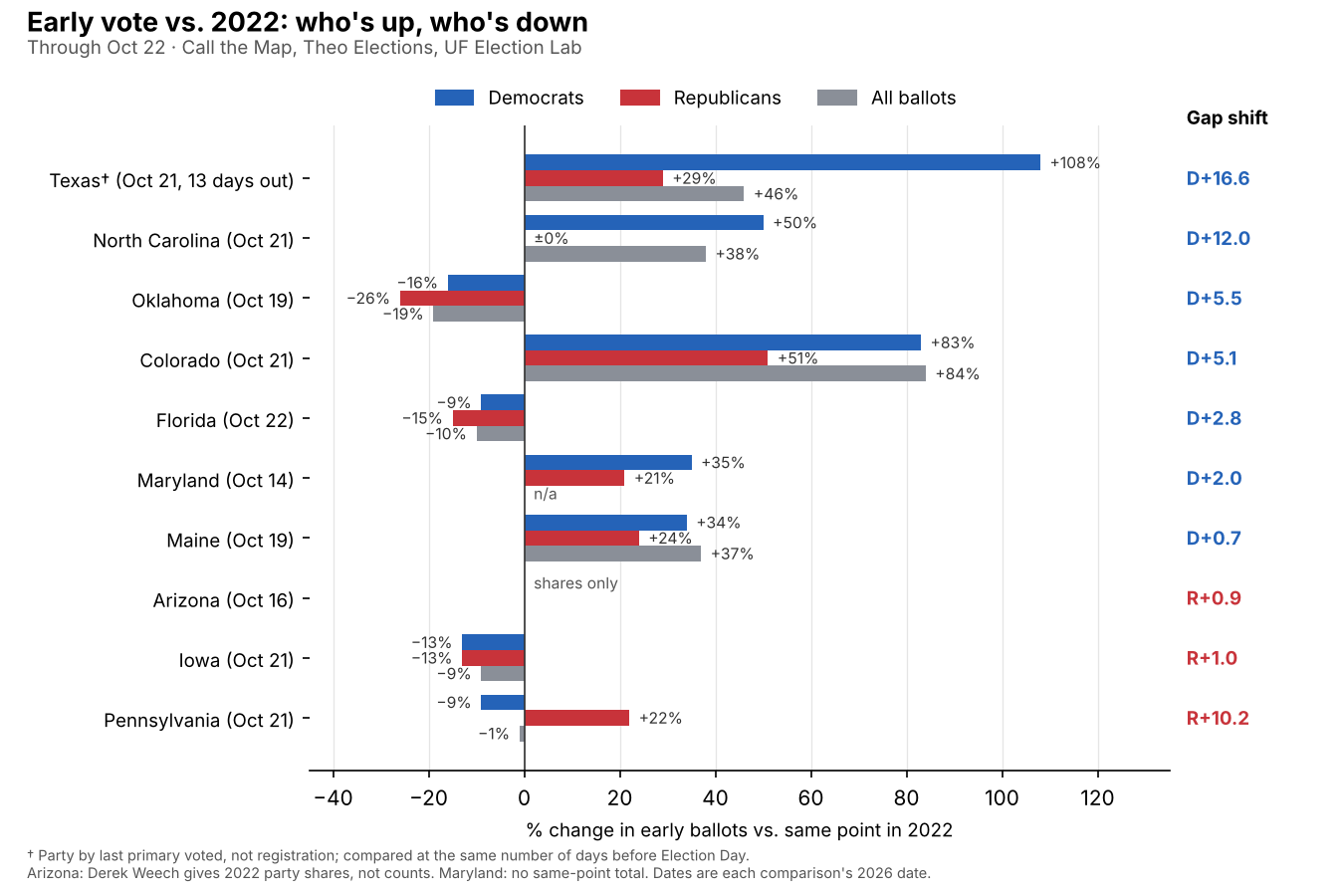
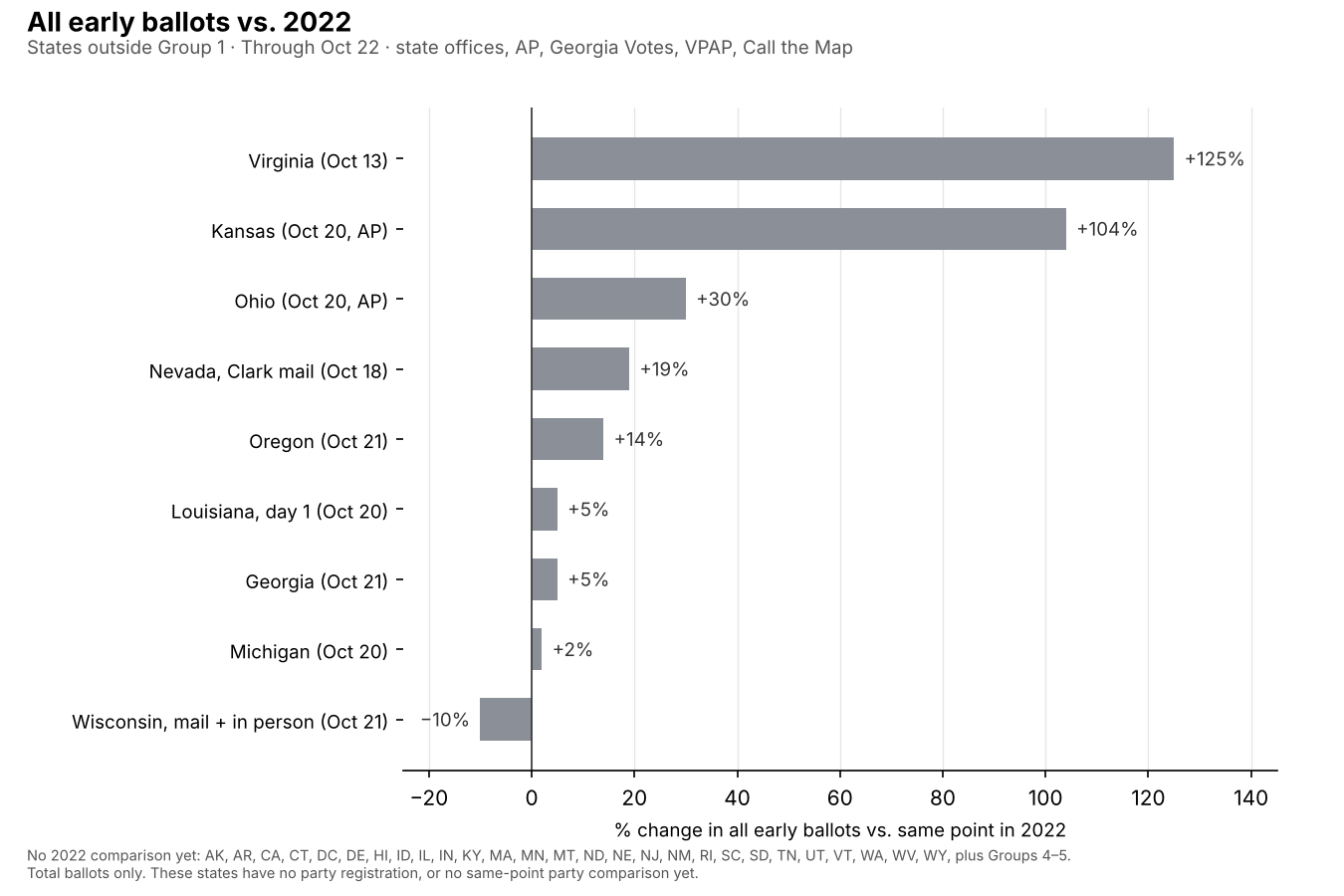
Mostly yes. Compared with the same point in 2022, Democrats look stronger in North Carolina, Texas, Ohio, and Virginia, and better in Colorado, Florida, Maryland, and Oklahoma, though fewer ballots are in so far than in 2022 in Oklahoma. North Carolina’s edge is D+20.5 vs D+8.5 through Oct 21, a 12-point gain, with Democratic ballots up 50% and Republican ballots even with 2022. In Texas, measured by the last primary each early voter chose (not registration), the early vote is D+2.8 vs R+13.8 at 13 days out in 2022 (through Oct 21, now nearly fully counted), a big gain, but the Democratic edge keeps shrinking as in-person votes are counted (D+8.1, D+4.7, then D+2.8 over the first three days), and more Texans voted in the March 2026 Democratic primary, which builds in part of that gain. Georgia’s turnout is 5% above 2022’s pace, and an AP analysis through Tuesday finds Kansas’s early vote more than double 2022’s and Ohio’s up 30%. Iowa slipped slightly behind 2022 on the headline (D+22.3 vs D+23.3, with ballots down 9%), but it’s ahead after adjusting for its weaker Democratic registration, so it’s partly explained: the registration shift explains the gap, but not the drop in ballots. Maine is about even with 2022 on the headline (D+32.7 vs D+32.0), though Democrats are ahead after adjusting for registration. Arizona is slightly behind its 2022 pace on the headline, but ahead after adjusting, so its gap is explainable. Nevada is explainable too: Democrats lead by about 4.5 points (11,300 ballots) in Jon Ralston’s Thursday morning tally, and Republicans lead in-person voting by far less than at this point in 2022, because many voters in both parties switched methods. Michigan’s flat mail is explainable, Wisconsin’s drop is likely a shift to in-person voting, not yet proven (its total is down about 10% with in-person votes counted), and Pennsylvania is only partly explained: it stays behind 2022 even after adjusting for registration (its Republican mail ballots are up 22%). Two states have no 2026 return data in UF’s file.
These numbers count who voted, not who they voted for. Party registration is not a vote.
What changed since yesterday
- Iowa slipped slightly behind 2022 on the headline. Call the Map’s newest comparison, through Oct 21, has Iowa at D+22.3 vs D+23.3 on the same day of voting in 2022 (Oct 26, 2022), with ballots down 9% and both Democratic and Republican ballots down 13% (unaffiliated up 18%). Last night it had D+24.2 vs D+22.0 and ballots down 6% through Oct 20. After adjusting for registration, Iowa is still about 4 points ahead of 2022 (from 7). UF’s newer count is 167,195 ballots at D+20.3 (from 124,444 at D+22.3), so the gap is still narrowing as in-person votes come in.
- North Carolina’s comparison now runs through Oct 21: still a 12-point gain. Call the Map has D+20.5 vs D+8.5 on the same day in 2022 (last night: D+22.1 vs D+9.1, a 13.0-point gain). Ballots are 1,101,318, up 38% (from 924,160). Democratic ballots are up 50%, unaffiliated 62%, and Republican ballots are now even with 2022. Michael Bitzer’s Day 7 post finds Republican in-person ballots 1.7% above 2022’s pace, the first time they’ve broken even, while Democrats are up 62% and unaffiliated voters 72% in person.
- Texas’s fuller count shows a smaller, but still large, Democratic gain. Theo Elections now has Oct 21 nearly complete (247 of 254 counties, including Harris): 2,361,882 early voters, up 46% from 1,618,470 at 13 days out in 2022, at D+2.8 by last primary vs R+13.8, a 16.6-point shift (last night: 1,519,923 voters through a partly counted Oct 20, and a 19.3-point shift for Oct 19). Voters whose last primary was Democratic are up 108%, Republican ones up 29%. Oct 20 filled in at 1,689,937 (D+4.7 vs R+13.6, an 18.3-point shift). About 27.1% of single-party Democratic primary voters have voted, vs 21.9% of Republican ones (18.7% and 13.2% last night), so Republicans are narrowing that gap. Texas’s Group 1 row now compares Oct 21 (13 days out).
- Other 2022 baselines moved. Call the Map’s Colorado comparison now runs through Oct 21 (Oct 26, 2022): ballots up 84%, not 116%, and the gap D+8.5 vs D+3.4. Florida’s now runs through a fuller Oct 22 count (Oct 27, 2022): D+1.6 vs R+1.2, with ballots down 10% (from D+3.0 vs D+0.1 and down 14% last night), Democratic ballots down 9%, and Republican ballots down 15%; the 2026 gap fell as in-person votes, which lean Republican, came in, but the matching 2022 day was more Republican too, so the gain over 2022 is about the same (2.8 points, from 2.9). Pennsylvania’s now runs through Oct 21: D+43.0 vs D+53.2, with ballots down 1% (from even), Democratic ballots down 9%, and Republican ballots up 22%. Call the Map also added a Maryland comparison that matches Oct 21, 2026 with Oct 31, 2022 by day of voting (D+52.7 vs D+42.0, ballots down 49%), but Oct 31, 2022 was 8 days before the election and after in-person voting had opened, so, like Colorado’s earlier day-of-voting match, it isn’t a same-point comparison. We keep Maryland’s Oct 14 figures.
- About 4.2 million more early votes came in, for 20.54 million total (from 16.39 million). The national split is 44.5% D, 29.2% R, and 26.3% other (from 46.7%, 29.6%, and 23.8%). Much of the shift in shares comes from California, whose newest file added about 455,000 ballots (2,326,426 in all) at D+17.4, from D+20.0 last night, with more voters outside the two major parties. UF’s Oregon count caught up to 271,544 (from 155,137), Delaware rose to 30,473 on its first in-person day (D+37.1, from D+45.3), Connecticut to 140,815 (D+37.6, from D+38.9), Massachusetts to 541,346, Alaska to 26,328, Rhode Island to 54,306, South Dakota to 41,057 (R+21.7), and UF’s Texas row to 2,270,617. Kansas rose to 122,344 ballots at D+10.8 (from 91,185 at D+13.8), Arkansas to 164,678 (from 115,503), and Ohio to 838,018 (from 763,784). Florida’s in-person votes in UF’s file reached 763,666, at R+6.6. Jon Ralston’s Thursday morning tally has Nevada Democrats up about 11,300 ballots, or 4.5 points (from 9,845 and 4.9 points Wednesday morning); UF’s Nevada file rose to 270,503 (D+4.1, from D+2.8). Louisiana’s gap fell to D+2.4 from D+5.7 as in-person votes came in (175,713 ballots), Nebraska’s to D+0.6 from D+1.6, and Arizona’s to D+0.5 from D+1.0 (743,697 mail ballots). Washington rose to 461,559 ballots (from 312,519). Wisconsin’s file rose to 420,287 (from 313,436), with 103,210 cast in person, but that total appears to count in-person votes twice: on the state’s own figure (317,077 through Oct 21), ballots are down about 10% from 2022, close to last night’s 11%. Call the Map now shows Wisconsin up 6% using the larger total, which we don’t use. Georgia stays 5% ahead of 2022 through Oct 21.
- New sources and openings. An Associated Press analysis (data through Tuesday) adds same-point totals: Kansas more than doubled from 2022 (more than 55,000 ballots vs 27,000), Ohio up 30% (156,000 more ballots), Maine up 39%, Iowa down about 6%, and Michigan and Georgia similar to 2022. Kansas and Ohio now have a 2022 total comparison, though not by party. Delaware and Maryland opened in-person voting today. Saturday, Oct 24, Florida opens statewide, and New Jersey, New York, and Michigan’s statewide early sites open. ABC News, using L2 voter-file data, finds registered and modeled Democrats a bigger share of early voters than at this point in 2024 in every state it checked except Alaska and Michigan (a 2024 comparison, not 2022). West Virginia now has early-vote data: UF’s file, from the Secretary of State, lists 16,922 in-person ballots since early voting opened Oct 21, at D+5.2, so West Virginia moves from Group 4 to Group 2. Theo Elections’ data files were blocked from the cloud shell at 9 p.m., so Texas figures are from the 6 p.m. reading. No new numbers today from Arizona (Derek Weech hasn’t posted since Oct 20) or Virginia sources, or from Ohio’s local outlets; WisPolitics and a WAVY Virginia story blocked automated reading, so their figures aren’t used. An Oakland University professor told CBS Detroit Michigan is about 17% ahead of 2022, but that matches the rise in requests, not the state’s 2% rise in returned ballots, so we keep the state’s figure.
Status at a glance (all 50 states plus DC)
| Group | States |
|---|---|
| 1. Party registration (or primary history), with a 2022 comparison | 10 |
| 2. Party registration, no 2022 comparison yet | 20 |
| 3. No party registration, voting underway | 16 |
| 4. No 2026 return data yet (most are voting by mail) | 2 |
| 5. Early voting only with an excuse | 3 |
National numbers (UF Election Lab, Oct 22, 8:37 p.m. ET)
| Measure | Count |
|---|---|
| Total early votes | 20.54 million |
| By mail | 11.68 million |
| In person | 8.86 million |
In states with party data (10.37 million ballots), the split is:
| Party | Share |
|---|---|
| Democrats | 44.5% |
| Republicans | 29.2% |
| Unaffiliated / other | 26.3% |
The UF tracker lists only each state’s final 2022 turnout, not same-day numbers. Texas isn’t in this split: its party measure is primary history, not registration (UF’s Texas row, 2,270,617 ballots, has no party data and lags Theo Elections’ count). The same-day comparisons below come from other trackers that rebuilt the 2022 files day by day. Many states’ UF rows are a day or more old; the “As of” time is when UF last refreshed its file.
Mail vs. in-person: where are voters shifting?
Many voters, especially Democrats, are skipping mail ballots this year and voting early in person instead, often citing doubts about the Postal Service. So a drop in mail ballots doesn’t always mean fewer voters. Where in-person early voting hasn’t opened yet, or doesn’t exist, those voters may show up later or on Election Day.
| State | Mail vs. 2022 | In-person early voting | What it may mean |
|---|---|---|---|
| Alaska | 9,084 mail ballots | Opened Oct 19; 17,244 in person (65% of early votes) | First counts; no 2022 comparison yet |
| Arizona | Party mix close to 2022 | Open since Oct 7, but not in UF’s counts | Hard to judge until in-person totals are tracked |
| Arkansas | Mail requires an excuse; 4,307 mail ballots | Opened Oct 19; 160,371 in person (97% of early votes) | Early voting here is mostly in person; no 2022 comparison yet |
| Colorado | All-mail state; ballots up 84% at 13 days out (ballots went out two weeks earlier this year) | Vote centers open since Oct 19 (2,972 votes so far) | Mail is the main method; the old 54% drop compared with a late-2022 date |
| Florida | Total ballots down 10% (GOP down 15%, Dems down 9%; Oct 22) | Some counties open since Oct 19 (763,666 votes, R+6.6); all by Oct 24 | Mostly a 2021 law change; in-person votes lean Republican, as usual in Florida |
| Georgia | Small (70,873 ballots) | Open since Oct 13; 95% of early votes | Voters strongly prefer in person; total early vote up 5% from the same point in 2022 |
| Iowa | Small (51,288 ballots) | Open since Oct 14; 69% of early votes | Call the Map: ballots down 9% from the same day in 2022 (Oct 21); its count trails UF’s |
| Kansas | Small (24,155 ballots) | Some counties open since Oct 14 (all by Oct 27); 80% of early votes | Early voting here is mostly in person; total early vote more than double 2022’s (AP, Oct 20) |
| Louisiana | 56,477 mail ballots | Opened Oct 20; 119,236 in person (68% of early votes) | No 2022 comparison past the first day; the gap narrows as in-person votes come in |
| Maryland | Dems up 35%, GOP up 21% (Oct 14) | Opened today (Oct 22) | No sign of a mail drop |
| Michigan | Ballots up 2%, requests up 17% (Oct 20) | New since 2024; sites open statewide Oct 24 (a few cities opened this week) | Some voters may wait for the new sites instead of mailing |
| Nevada | Clark mail D+13.4 vs D+23.2 in 2022 (Oct 18); Dem mail up 3%, GOP up 34% | Open since Oct 17; 98,367 in person statewide in UF’s file (R+5.1), vs about R+9 at this point in 2022 | Voters in both parties switched methods; Democrats lead overall (about 4.5 points in Ralston’s Thursday morning tally) |
| North Carolina | Down 31% (Oct 21) | Open since Oct 15; up 45% through Oct 21 (Bitzer); 1,050,226 in person (UF) | The shift is real, and in-person gains far outweigh the mail drop |
| Ohio | Requests down about 28% | Open since Oct 6; nearly 4 times 2022 after week one | The mail drop is a move to in-person voting; total early vote up 30% (AP, Oct 20) |
| Pennsylvania | Dems down 9%, GOP up 22% (Oct 21); Dem requests down 14% | None (in-person votes at county offices count as mail) | Democrats who skip mail will likely vote on Election Day, so early numbers may understate them |
| South Carolina | Mail requires an excuse; UF’s newest file lists no mail ballots separately | Opened Oct 19; 280,114 early votes, all listed as in person | No 2022 comparison yet |
| Texas | Mail requires an excuse; mail is a small share | Opened Oct 19; most of the 2,361,882 early votes through Oct 21 were in person (Theo) | Total early vote up 46% from 2022 at 13 days out (Oct 21); Harris County up 59% through three days |
| Virginia | 242,684 so far | Open since Sep 18; 72% of early votes | Total was roughly double 2022 (as of Oct 13) |
| Wisconsin | Mail down about 26% (Votebeat and Call the Map, Oct 19-20) | In-person absentee opened Oct 20; 103,210 in-person votes in UF’s newest file; first day up 65% from 2022’s (WPR); mail plus in person down about 10% (state file, Oct 21) | In-person votes already make up much of the mail drop; Votebeat finds voters moving to in person out of distrust of the Postal Service |
D−R gap is the Democratic share of ballots minus the Republican share.
Group 1: Party registration (or primary history), with a same-day 2022 comparison
The 2026 and 2022 gaps were measured on the same day. “Now” is the latest 2026 gap from UF (Texas: Theo Elections).
| State | Compared on | 2026 gap | 2022 gap | Now | What changed |
|---|---|---|---|---|---|
| Arizona | Oct 16 | D+3.9 | D+4.8 | D+0.5 | Slightly behind 2022; ahead after adjusting |
| Colorado | Oct 21 (13 days out) | D+8.5 | D+3.4 | D+8.6 | Gap better; ballots up 84%, mostly timing |
| Florida | Oct 22 (12 days out) | D+1.6 | R+1.2 | D+1.7 | Ballots down 10%; GOP down more than Dems |
| Iowa | Oct 21 | D+22.3 | D+23.3 | D+20.3 | Gap slightly worse; ballots down 9% |
| Maine | Oct 19 | D+32.7 | D+32.0 | D+32.0 | About even; total ballots up 37% |
| Maryland | Oct 14 | D+51.4 | D+49.4 | D+52.7 | Dems up 35%, GOP up 21% |
| North Carolina | Oct 21 | D+20.5 | D+8.5 | D+20.5 | Ballots up 38%; GOP even with 2022 |
| Oklahoma | Oct 19 | D+0.9 | R+4.6 | R+0.2 | Gap better; total ballots down 19% |
| Pennsylvania | Oct 21 | D+43.0 | D+53.2 | D+42.9 | Dems down 9%, GOP up 22% |
| Texas† | Oct 21 (13 days out) | D+2.8 | R+13.8 | D+2.8 | Ballots up 46%; last-primary-D voters up 108%, R up 29% |
† Party measured by last primary voted, not registration. 2022 is compared at the same number of days before Election Day (Oct 26, 2022). “Now” is Theo’s latest full day (Oct 21) as of 6 p.m.; Theo’s files couldn’t be read at 9 p.m. Colorado, Iowa, and North Carolina are compared on Oct 21, 2026 and Oct 26, 2022, and Florida on Oct 22, 2026 and Oct 27, 2022, the same number of days before Election Day.
Adjusting for registration
Democrats make up a smaller share of registered voters than in 2022 in every one of these states that we could check. So matching their 2022 early-vote share is harder now. This table compares each year’s early-vote gap with that year’s registration gap (D% minus R% of registered voters).
| State | Reg. gap 2022 | Reg. gap now | Early vote over reg., 2022 | Early vote over reg., 2026 | Headline change | Adjusted change |
|---|---|---|---|---|---|---|
| Arizona | R+4.0 | R+7.3 (Jul) | +8.8 | +11.2 | −0.9 | +2.4 |
| Florida | R+2.1 | R+11.3 | +0.9 | +12.9 | +2.8 | +12.0 |
| Iowa | R+4.8 | R+9.8 | +28.1 | +32.1 | −1.0 | +4.0 |
| Maine | D+7.0 | D+3.5 (Mar) | +25.0 | +29.2 | +0.7 | +4.2 |
| Maryland | D+30.1 | D+28.0 | +19.3 | +23.4 | +2.0 | +4.1 |
| North Carolina | D+3.7 | Even | +4.8 | +20.5 | +12.0 | +15.7 |
| Pennsylvania | D+6.2* | D+2.6 | +47.0 | +40.4 | −10.2 | −6.6 |
Florida’s figures come from the Florida Division of Elections (the Oct 11, 2022 book closing and Sep 30, 2026). Its year-end 2022 row gives R+2.6 instead, which would make the adjusted change +11.5. The other states’ figures come from Shiftline, which compiles state filings, and aren’t yet checked against each secretary of state. “Now” is the latest filing: Sep 30 to Oct 10, 2026, except Arizona (Jul 14) and Maine (Mar 7), which are stale. *Shiftline’s 2022 row for Pennsylvania is dated Nov 2021, a year early. Oklahoma and Colorado aren’t in the table yet: their registration figures weren’t checked (Shiftline’s Oklahoma page didn’t load from the shell).
Texas (no registration, so a different adjustment): Among voters with a recent Democratic primary history, about 27.1% of single-party Democratic primary voters have voted early (852,977), vs about 21.9% of single-party Republican primary voters (809,378), per Theo Elections; last night’s figures were 18.7% and 13.2%. Republicans are closing the turnout-rate gap as in-person voting goes on. Derek Ryan’s first-day report found a similar pattern among the most reliable primary voters (21% of Democrats vs 13% of Republicans). Theo has no matching 2022 rate, so there’s no adjusted change yet. More Texans voted in the March 2026 Democratic primary than the Republican one, so part of the Democratic share gain is built in before anyone votes; the turnout rates are the better test, and they still favor Democrats, by less than on the first days.
Caveat: Registration isn’t the electorate. Part of the Democratic registration decline, especially in North Carolina, Florida, and Pennsylvania, comes from long-time conservative Democrats re-registering as Republican or unaffiliated, and many of them weren’t voting for Democrats anyway. The truth is likely between the headline and the adjusted number. In Arizona, most early ballots go to voters on the early-voting list, so registration is a rougher baseline there. Florida’s large shift also reflects voter-list cleanup and the 2021 mail law, so its adjusted number overstates the gain.
- Arizona (explainable): On the headline, the Democratic edge is below 2022’s at the same point. But Arizona’s registration has moved about 3 points toward Republicans since 2022, which is more than the gap. So Arizona looks roughly even with 2022, not behind. UF’s and Call the Map’s latest gap (D+0.5, from 743,697 mail ballots through Oct 21, down from D+1.0 last night) is lower still, but it isn’t from the same day as the 2022 figure. Derek Weech’s Oct 20 post counts 514,905 returned ballots at D+1.9 (39.7% D, 37.8% R); his 2022 comparison for that day is behind a sign-up wall, so the Oct 16 figure stays, and he hasn’t posted since. A partisan site, WLT Report, citing unnamed trackers, claims Arizona’s returns run about 6% behind 2022 and Maricopa’s gap is D+1.4 vs D+2.8 in 2022; its statewide count (401,968) is far below UF’s, so we can’t check it and don’t use it. Maricopa County mail delays may slow returns, and in-person early votes aren’t in UF’s counts yet. The 2022 figure rests on one analyst.
- Colorado (ballot count explained): Colorado votes almost entirely by mail. Call the Map compares it at the same number of days before Election Day: through Oct 21, 2026 vs Oct 26, 2022, ballots are up 84% (661,879 vs 360,593), and the gap is D+8.5 vs D+3.4. Democratic ballots are up 83%, Republican ballots 51%, and unaffiliated 111%. Last night’s comparison, through Oct 20, had ballots up 116%; the rise slows as 2022’s late returns catch up. Most of the ballot jump is timing: ballots went out Oct 2 this year but Oct 17 in 2022, so 2022 had only about a week of returns at this point. Earlier, Call the Map matched the two years by day of voting, which compared Oct 19, 2026 with Nov 3, 2022 and showed a false 54% drop. The Secretary of State counts 509,364 ballots through Oct 19, and Colorado Newsline and CPR both say turnout is ahead of the same point in 2022. Early 2022 returns may have leaned more Democratic than the full early vote, so treat the gap gain with some caution.
- Florida (ballot drop explainable): A 2021 law (SB 90) canceled standing mail requests, which explains much of the 10% drop in ballots. Michael McDonald notes 2026 is the first election where holdover requests lapsed: Florida has about 2.4 million mail requests, vs 4.3 million over all of 2022’s early voting. Republican ballots fell more than Democratic ballots (15% vs 9%), and the party gap is better for Democrats than in 2022, even before adjusting for registration. Through Oct 22, Call the Map has 1,976,009 ballots at D+1.6, vs R+1.2 on Oct 27, 2022, the same number of days before Election Day, with ballots down 10% (through Oct 21 it was D+3.3 vs D+0.1). Some counties opened in-person voting on Oct 19, and all must open by Oct 24. UF now counts 763,666 in-person votes, leaning Republican (R+6.6), out of 1,981,475 ballots, and the overall gap is D+1.7. Republicans in Florida traditionally do better in person than by mail, and the gap is already narrowing as in-person voting expands.
- Iowa (partly explained): Call the Map compares Iowa by day of early voting. Its newest comparison, through Oct 21 (day 8, matched with Oct 26, 2022), has ballots down 9% (124,444 vs 136,616) and the gap at D+22.3 vs D+23.3, slightly behind 2022. Democratic and Republican ballots are both down 13%, and unaffiliated ballots up 18%. Last night, through Oct 20, it had D+24.2 vs D+22.0 and ballots down 6%. After adjusting for registration, which has moved 5 points toward Republicans since 2022, Iowa is still about 4 points ahead of 2022. That explains the gap, but not the drop in ballots, which no known law change or new voting option accounts for. Call the Map’s count lags: UF’s newer file has 167,195 ballots at D+20.3, 69% of them in person, and the gap keeps narrowing as in-person votes come in. G. Elliott Morris found Iowa’s first-day ballots were D+27, compared with D+11 on the first day in 2022.
- Maine: Through Oct 19, total ballots are up 37% from the same point in 2022 (Call the Map revised this from 47% on Tuesday), and the gap (D+32.7) is slightly above 2022’s (D+32.0). After adjusting for registration, Democrats are about 4 points ahead of 2022. Tom Bonier noted on Oct 14 that the Democratic share of Maine’s early vote is down, and most of the growth is unaffiliated voters.
- Maryland: In-person voting opened today, Oct 22. The Oct 14 comparison (Democratic ballots up 35%, Republican up 21%) is the latest true same-point one. Call the Map now also compares Oct 21, 2026 with Oct 31, 2022, the same day of voting but 8 days before Election Day instead of 13, after 2022’s in-person voting had started. That shows ballots down 49% and the gap at D+52.7 vs D+42.0, but those 2022 figures come from a later point in the race, so we don’t use them. UF’s latest 2026 gap is D+52.7 (242,744 ballots).
- Oklahoma: Through Oct 19, Democrats lead registered-party ballots by 0.9 points, vs a Republican edge of 4.6 points on the same day in 2022, but total ballots are down 19%. UF’s newer count (22,874 ballots, through Oct 21) is R+0.2, a sign the gap is already moving. In-person voting starts Oct 28, and Republicans led the final 2022 early vote by 14.4 points, so this early gap will likely shift a lot.
- North Carolina: Through Wednesday, Oct 21, Michael Bitzer counts 1,101,318 ballots, up 38% from the same day in 2022. In-person votes are up 45%, and mail ballots are down 31%. Among in-person voters, Democrats are up 62% (452,221 vs 280,097), unaffiliated voters 72% (356,594 vs 207,710), and Republicans 1.7% (239,079 vs 235,174), the first time Republicans have broken even with their 2022 pace. Democrats and unaffiliated voters make up 77% of in-person early voters. Call the Map has the gap at D+20.5 vs D+8.5 on the same day in 2022, a 12-point gain (13.0 through Oct 20), with all Democratic ballots up 50%, Republican ballots even, and unaffiliated up 62%. Bitzer finds 10% of 2022’s Election Day voters have already voted early this year. G. Elliott Morris finds the early vote is running about 18 points bluer than its usual lean compared with the voter rolls, the most since at least 2006. Registered Democrats and Republicans are now even, down from D+3.7 in 2022, so the Democratic gain is bigger than the headline.
- Pennsylvania (partly explained): The state votes by mail only, so a Democratic shift away from mail shows up here as a drop. With no early in-person option, Democrats who skip mail will likely vote on Election Day instead, so Pennsylvania’s early numbers may understate them. Votebeat’s Oct 19 data shows the drop starts with requests: Democratic requests are down 14% and Republican requests up 11% from 2022, and Democrats have returned a smaller share of their ballots (47% vs 51%). Democratic strategist J.J. Abbott told Votebeat most of the Democratic drop is voters switching to in-person voting; MIT’s Charles Stewart cautions that the data can’t show why. Adjusting for registration narrows the gap but doesn’t close it. Tom Bonier attributes the Republican gains to the party’s new push for mail voting; if so, some of those Republican mail voters are Election Day voters voting earlier. County offices opened for in-person mail-ballot voting Tuesday. Call the Map’s comparison now runs through Oct 21 and covers 66 of 67 counties: D+43.0 vs D+53.2, with total ballots down 1% from 2022, Democratic ballots down 9%, Republican ballots up 22%, and unaffiliated up 10%.
- Texas (party by primary history): Theo Elections matches each early voter to the state’s voter rolls. Through Oct 21, 13 days before Election Day and now nearly fully counted (247 of 254 counties), 2,361,882 Texans had voted early: 39.3% last voted in a Democratic primary, 36.5% in a Republican one, and 24.2% in neither (D+2.8). At 13 days out in 2022 (Oct 26), the split was 27.6% D, 41.4% R, and 31.0% neither (R+13.8), out of 1,618,470. Voters with a Democratic primary history are up 108%, Republican ones up 29%, and the total up 46%. The Democratic edge has narrowed each day as more in-person votes came in: D+8.1 on Oct 19, D+4.7 on Oct 20 (1,689,937 voters, vs R+13.6 at 14 days out in 2022), and D+2.8 on Oct 21. The 2022 gap also widened over those days, but less, so the shift vs 2022 has slipped from about 19 points to 16.6. Theo’s count now has 327,353 votes from Harris County, matching the county’s own three-day total (327,691), up 59% from 205,743 in 2022 (Off the Kuff). Cautions: a primary vote isn’t party membership, and Texas primaries are open; about a fifth of early voters have no recent primary; the March 2026 Democratic primary drew about 146,000 more voters than the Republican one (per Derek Ryan), which moves the baseline toward Democrats; and Theo’s 2026 file looks back over four primaries while its 2022 file covers two, which shrinks 2026’s “no primary” group and may inflate both parties’ 2026 shares. Big counties set first-day records: Bexar up 32% from 2022 (Texas Public Radio), El Paso up 90% (El Paso Matters; we could read only the headline), Travis about 4.3% of registered voters vs 2.8% (KUT), and records in Harris and Dallas (KRLD/Audacy, Fox 4). Counties first had to clear about 15,000 backlogged voter address updates, per Votebeat. Derek Ryan’s first-day report says Day 1 ran more than 20% above 2022, and mail ballots so far come 50% from Democratic-primary voters and 30% from Republican ones. Tom Bonier’s modeled data (Oct 22) shows turnout rates among Hispanic, Black, and Asian American Texans above 2022’s in every age group, and white seniors 3 points below 2022.
Group 2: Party registration, voting underway, no 2022 comparison yet
These numbers show where things stand, but no tracker has same-day 2022 numbers for these states yet.
| State | Ballots | D−R gap | Notes |
|---|---|---|---|
| Alaska | 26,328 | n/a | No party data in UF’s file; 17,244 in person |
| California | 2,326,426 | D+17.4 | In person since Oct 5; party data keeps swinging |
| Connecticut | 140,815 | D+37.6 | In person since Oct 19 (112,976 votes) |
| Delaware | 30,473 | D+37.1 | In person opened today (Oct 22) |
| DC | 31,649 | n/a | No party data; in person starts Oct 26 |
| Idaho | 115,031 | R+39.3 | Gap covers mail ballots only; 44,336 in person |
| Kansas | 122,344 | D+10.8 | In person in some counties; all by Oct 27; ballots more than double 2022’s (AP, Oct 20) |
| Kentucky | 28,379 | D+16.7 | No-excuse in person starts Oct 29; 2,975 in-person absentee votes so far (R+13.8) |
| Louisiana | 175,713 | D+2.4 | In person since Oct 20 (119,236 votes); first day up 5% from 2022’s |
| Massachusetts | 541,346 | n/a | Party data held back |
| Nebraska | 125,954 | D+0.6 | In person since Oct 5; in-person votes R+11.3 |
| Nevada | 270,503 | D+4.1 | Ralston’s Thursday morning tally: Dems up about 11,300 (4.5 points) |
| New Jersey | 417,489 | D+46.7 | In person starts Oct 24 |
| New Mexico | 187,880 | D+29.3 | In person since Oct 6 |
| Oregon | 271,544 | D+23.4 | All-mail state; up 14% from 2022 through Oct 21 (Call the Map) |
| Rhode Island | 54,306 | D+37.5 | In person since Oct 14 |
| South Dakota | 41,057 | R+21.7 | In person since Sep 18 |
| Utah | 114,999 | R+28.6 | Mostly mail; in person opened Oct 20 |
| West Virginia | 16,922 | D+5.2 | In person since Oct 21; first counts in UF’s file |
| Wyoming | 29,348 | R+55.0 | In person since Oct 6 |
- Alaska: UF’s Alaska counts have 26,328 ballots (9,084 by mail, 17,244 in person) but no party breakdown. For scale, the state received 100,877 absentee, early, and questioned ballots in the whole 2022 general election. Most Alaskans register as nonpartisan or undeclared, so party data tells less there than in most states.
- California: UF’s party sorting keeps swinging: voters outside the two major parties made up about 25% of ballots in Tuesday evening’s file and about 22% since. UF’s Thursday evening file has 2,326,426 ballots at D+17.4, vs D+20.6 this afternoon, D+20.0 in Wednesday night’s file, D+17.3 on Tuesday evening, and D+15.6 on Monday; about 33% of ballots in the newest file are from voters outside the two major parties. Read day-to-day changes in California’s gap with caution. Votebeat reports the Justice Department is moving to challenge up to 20,000 California ballots while early voting is underway.
- Kansas: Ballots keep climbing as in-person votes come in (98,189 so far, D+8.9), and the gap narrowed to D+10.8, from D+13.8 last night and D+24.2 before in-person votes entered UF’s file. Johnson County, the state’s largest, cast 12,600 votes on its first Saturday of early voting, compared with about 14,500 on the first Saturday of 2024, per the county election commissioner (KCTV5). An AP analysis finds more than 55,000 Kansans had voted through Tuesday, more than double the 27,000 at the same point in 2022, but it has no party comparison, so Kansas stays in this group. Daniel Nichanian (Bolts) notes that a new state law has invalidated the IDs of many transgender Kansans, which could affect their ability to vote.
- Louisiana: UF’s Louisiana counts have 175,713 ballots: 119,236 cast in person since early voting opened Oct 20, and 56,477 by mail. Registered Democrats lead by 2.4 points, down from 5.7 last night, as in-person votes, which lean less Democratic, came in. Louisiana’s mail voting requires an excuse. Call the Map counts the first day’s total up 5% from the first day of early voting in 2022 (Oct 25, 2022), but has no 2022 party comparison and no later day, so Louisiana stays in this group.
- Massachusetts: The state’s party counts don’t add up, so UF leaves them out until the state explains the gap.
- Nebraska: The gap narrowed to D+0.6, from D+1.6 last night and D+5.1 earlier in the week, as more in-person votes, which lean Republican (R+11.3), came in. No same-day 2022 comparison found.
- Nevada (explainable): Jon Ralston’s Thursday 7 a.m. update says Clark and Washoe accepted 4,600 more mail ballots overnight, pushing the Democratic lead to about 11,300 ballots, or 4.5 points, with about 12% of active voters having voted and a quarter or so of the total vote in. Democrats are 40% of voters so far, Republicans 35%, and others 25%, and Democrats are turning out at a higher rate in every region. Clark is voting below its share of active voters (66% of ballots vs 73% of voters), while Washoe and the rurals are above theirs. The pattern has settled: Republicans lead in-person voting early in the day, Democrats cut into that later, and Democratic mail ballots outweigh the small Republican in-person lead. He puts the Democratic lead in urban Nevada (Clark and Washoe) at just under 10 points, about 1.4 points better than after five days in 2022, when Republicans went on to win the governor’s race; Republicans won Election Day 2022 by about 2 to 1. UF’s newer file has 270,503 ballots at D+4.1, with in-person votes R+5.1 (it now lists 98,367 in-person votes, fewer than earlier today, so its in-person count is being revised). The reason Clark’s mail looks weaker for Democrats than in 2022 (D+13.4 vs D+23.2 in Call the Map’s Oct 18 comparison, with Republican mail up 34% and Democratic mail up 3%) appears to be method switching in both parties: voter-file data from Erik Jimenez, a Democratic data analyst Ralston cites, shows about a quarter of 2022’s in-person voters in every party are voting by mail this year (Democrats 24%, Republicans 26%, nonpartisans 25%). No tracker yet compares statewide mail plus in-person with 2022, so Nevada stays in this group; the switching numbers come from one Democratic analyst and aren’t independently checked.
- New Jersey: Democrats are well ahead of where they were in 2025, but that compares with a governor’s race, not with 2022.
- Oregon: Call the Map counts 271,544 ballots through Oct 21 (D+23.4), up 14% from the same day in 2022 (20% through Oct 20), but has no 2022 party comparison yet. UF’s file now matches that count.
- West Virginia: UF’s file, from the Secretary of State, now has 16,922 ballots, all cast in person since early voting opened Oct 21 (mail voting requires an excuse, and the state reports no mail figure during voting). Registered Democrats lead by 5.2 points, but many West Virginia Democrats vote Republican in federal races, so the gap says even less about vote choice there than elsewhere. No same-day 2022 comparison found.
Group 3: No party registration, voting underway
These states don’t register voters by party, so this section uses raw volume, geography, and race where those numbers exist.
| State | Ballots | Compared with 2022 |
|---|---|---|
| Arkansas | 164,678 | No 2022 comparison found |
| Georgia | 1,330,455 | Up 5% from the same point in 2022 (1,330,455 vs 1,268,916, through Oct 21) |
| Hawaii | 79,348 | All-mail state; voting centers opened Oct 20 |
| Illinois | 601,151 | No 2022 comparison found |
| Indiana | 261,094 | No 2022 comparison found |
| Michigan | 920,773 | Up 2%: 789,572 vs 771,967 two weeks out (Oct 20) |
| Minnesota | 202,252 | No 2022 comparison found |
| Montana | 137,265 | No 2022 comparison found |
| North Dakota | 28,238 | No 2022 comparison found |
| Ohio | 838,018 | Up 30% from the same point in 2022 (AP, Oct 20); in person nearly 4 times 2022 after week one |
| South Carolina | 280,114 | No 2022 comparison found |
| Tennessee | 577,423 | Nashville’s first day about 15 times 2022 |
| Vermont | 88,111 | No 2022 comparison found |
| Virginia | 870,213 | 450,000 vs just over 200,000 (as of Oct 13) |
| Washington | 461,559 | All-mail state; no 2022 comparison found |
| Wisconsin | 420,287 | Down about 10% from the same point in 2022 on the state’s Oct 21 file (317,077 vs 353,929); UF’s total may count in-person votes twice; mail alone down about 26% |
- Arkansas: In-person voting opened Oct 19, and 97% of early votes so far were cast in person (voting by mail requires an excuse). UF’s file assigns party from primary voting history: 84% of early voters have none, and the rest split nearly evenly (R+1.4). That isn’t party registration.
- Georgia: Georgia Votes, which compares the state’s voter file with 2022 at the same point, counts 1,330,455 early voters through Wednesday, up 5% from 1,268,916 in 2022 (also up 5% through Tuesday). The record first day, up 40%, didn’t last. Of this year’s early voters, 73.3% also voted early in 2022, 10.6% voted on Election Day in 2022, and 16.1% didn’t vote in the 2022 general. Georgia Votes puts Black voters at 33.8% of early voters (34.3% on Tuesday); Tom Bonier puts that against 28% at this point in 2024. Daniel Nichanian (Bolts) finds the state’s 10 biggest Democratic-leaning counties cast 50.0% of the vote through Oct 18, compared with 45.6% of the final early vote in 2024. G. Elliott Morris says Georgia’s early vote is running 7.4 points bluer than its usual norm, against a previous high of 2.3; Georgia has no party registration, so that rests on modeled party. Nichanian and Morris both caution that these voters may just be voting earlier than usual.
- Michigan: As of Oct 20, two weeks before Election Day, 789,572 voters had cast ballots, 2% more than the 771,967 who had returned ballots two weeks out in 2022 (Oct 24, 2022), per the Secretary of State. Requests are up 17% (2,121,458 vs 1,810,569). The share of requested ballots returned is lower (37% vs 43%), but that’s explainable: since 2022, voters on the permanent list get their ballots mailed automatically, which inflates requests. Michigan’s early in-person voting sites, new since 2024, open statewide Oct 24 (East Lansing, Grand Rapids, and a few others opened this week), so some voters may be waiting to use them instead of mailing. The state now urges voters to hand-deliver mail ballots to avoid postal delays. UF’s newer count is 920,773, with no same-point 2022 figure. An AP analysis through Tuesday also finds Michigan’s early vote high but similar to 2022’s. Oakland University’s Peter Trumbore told CBS Detroit (Oct 21) that Michigan is “about 17% ahead” of 2022; that matches the rise in requests, not returned ballots, so we keep the state’s 2% figure.
- Ohio: An AP analysis (Oct 22) finds 156,000 more ballots cast through Tuesday than at the same point in 2022, a 30% increase. It notes that Ohio ended its grace period for mail ballots that arrive after Election Day, which pushes voters to return them earlier. No new early-vote numbers in the last 48 hours from Signal Ohio, Signal Cleveland, the Ohio Capital Journal, or the Statehouse News Bureau (checked Thursday at 3 p.m.). After the first week, 194,841 people had voted early in person, compared with 50,368 at the same point in 2022. Absentee requests fell from 871,041 to 631,079. Party here is based on which primary a voter last chose. In Hamilton County, Democrats returned about 7,800 ballots, compared with about 2,000 in 2022.
- South Carolina: UF’s newest South Carolina file has 280,114 ballots since in-person voting opened Oct 19, and now lists them all as in person (yesterday’s file split out 21,501 mail ballots; mail voting requires an excuse). South Carolina has no party registration, and UF’s counts carry no race breakdown. No same-day 2022 comparison found.
- Tennessee: Nashville’s first day of early voting ran about 15 times its 2022 level, but 2022 had no open governor’s race. Compared with 2018, the first day was down about 20%.
- Virginia: G. Elliott Morris, using the L2 voter file’s modeled party, finds early voters so far break 60% D to 36% R, compared with 55% to 40% at this point in 2024. That’s a 2024 comparison and modeled, not registered, party.
- Wisconsin: The size of the drop depends on the 2022 baseline. Votebeat counts about 191,000 returned ballots as of Tuesday vs nearly 259,000 at the same time in 2022 (down about 26%), with ballots sent down about 20% (372,000 vs 466,000) and the return rate lower (51.5% vs 55.5%) in 63 of 72 counties. Call the Map had mail ballots down 26% too, before in-person votes came in. The Wisconsin Examiner, citing Elections Commission data as of Monday morning, had a smaller drop (173,164 vs 195,287, down 11%), likely using a different 2022 date. Racine County Eye found returns down 29% as of Oct 16. Wisconsin Public Radio, citing Elections Commission data, reports that first-day in-person absentee votes ran 65% above the first day in 2022, with all but five of 72 counties higher (Milwaukee County up 63%, Dane up 60%, Kenosha up 87%), while mail ballots were down nearly 26%. Madison fell about 70% as of Oct 13, and the Dane County clerk blamed low trust in the Postal Service. Both parties are steering voters toward in-person absentee voting, which opened Tuesday, so some of the drop may be voters switching methods; Votebeat found voters doing just that, citing distrust of the Postal Service, though New Berlin’s clerk called the first in-person day “about as busy as usual.” Elections Commission administrator Meagan Wolfe urged clerks to prepare for higher in-person turnout. UF’s newest file has 420,287 ballots, which it splits into 317,077 by mail and 103,210 in person. But the state’s own Oct 21 file, as Call the Map reads it, has 317,077 ballots in all, including the 103,210 cast in person, so the 420,287 total appears to count in-person votes twice. On the state’s figure, ballots are down about 10% from the same number of days before Election Day in 2022 (353,929 on Oct 26, 2022), far less than the 26% mail drop. Call the Map now shows Wisconsin up 6% (420,287 vs 397,174 on Oct 27, 2022), but that uses the larger total, so we don’t use it until the state’s next file settles the count. Over the last four days that both years have counts, ballots added ran 15% above 2022 (about 150,000 vs 130,000). In 2022, in-person absentee voting opened Oct 25, so the 2022 figure includes about two days of it; this year’s count appears to include one, so the gap may narrow further. Superior’s city clerk told Northern News Now that turnout so far is on par with 2022.
Group 4: No 2026 return data yet
“No data” doesn’t mean voting hasn’t started. Every one of these states is already voting in person, by mail, or both; they just don’t post return counts that UF can use yet.
| State | Party registration? | Mail ballots out | In person starts | Notes |
|---|---|---|---|---|
| Missouri | No | Sep 22* | Oct 20 | In person is no-excuse absentee |
| New York | Yes | Sep 18 | Oct 24 |
* In these states, voting by mail requires an excuse (age, illness, travel, and similar). Early in-person voting does not.
Group 5: Early voting only with an excuse
These states let people vote early only with a valid reason, such as illness or travel.
| State | Party registration? | Notes |
|---|---|---|
| Alabama | No | No data reported |
| Mississippi | No | 29,647 absentee ballots (UF, Oct 19) |
| New Hampshire | Yes | No data reported |
What analysts are saying
- ABC News (Oct 22), using L2 voter-file data run Tuesday, finds registered Democrats and voters modeled as likely Democrats make up a bigger share of early voters than at this point in 2024 in every state it checked except Alaska and Michigan, where the share is similar; in Georgia and Iowa the early vote is about 18 points more Democratic than in 2024. It cautions that the early vote says nothing about low-propensity voters, and that Republicans have done much better on Election Day. Our check: that’s a 2024 baseline, not 2022, and partly modeled party; it fits Tom Bonier’s Oct 21 table vs 2024, and Georgia’s direction fits Morris’s modeled figure.
- The Associated Press (Oct 22), using data through Tuesday, finds early votes up sharply from the same point in 2022 in many Senate battlegrounds: Texas up 74%, Kansas more than doubled, and Maine, North Carolina, and Ohio up more than 30%, while Michigan and Georgia are similar to 2022 and Iowa is down about 6%. Nationally it counts more than 13 million early votes vs 9 million in 2022, partly because more states now offer early voting or publish data. In most of those states, Republicans make up a smaller share of early voters than four years ago. Our check: Maine (AP 39%, Call the Map 37%), Georgia (up 5%), and Iowa (Call the Map had down 6% through Oct 20) agree. Its Texas figure (nearly 1 million vs about 550,000) is an earlier count than Theo Elections’ fuller one, which shows 47% more early voters at 14 days out.
- Michael Bitzer (Center for NC Politics, Oct 22) writes that North Carolina is on pace for a record midterm, already halfway to 2022’s total early vote with 10 days to go. He finds a week of in-person voting has “locked in” Democratic and unaffiliated dominance (77% of in-person ballots), while Republicans have “finally broken even” with their 2022 pace. Our check: his 1,101,318 ballots and 38% rise match Call the Map’s and UF’s North Carolina counts.
- Jon Ralston (The Nevada Independent, Oct 22, 7 a.m.) says that with about a quarter of the vote in, “a trend has been established,” and asks whether Republicans can make up the gap by or on Election Day; he sees “some evidence” of Republicans moving Election Day voters into early voting but says more data is needed. He still expects about 1.1 million total votes. Our check: his lead (11,300 ballots, 4.5 points) is a bit larger than in UF’s file (D+3.5 of 269,277), which counts ballots differently.
- Michael McDonald (Oct 22) writes that Florida’s mail decline is “a certainty” under SB 90, since 2026 is the first election in which old mail requests lapsed, and that the question is whether Democrats, who use mail more, make it up in person. The rest is paywalled. Our check: it fits Call the Map’s Florida numbers (ballots down 10%, with Republicans down more than Democrats so far).
- Tom Bonier (TargetSmart, Oct 22) writes that Democrats feel good about Texas because voters of color are turning out at high rates, in many cases above presidential-year levels. In his modeled data, Hispanic turnout as a share of registration beats 2022 in every age group and more than doubles it among voters under 30; Black and Asian American voters also beat 2022 in every age group. White voters lag: seniors are 3 points below 2022, and modeled white Republican seniors 6 points below. Our check: the direction fits Theo’s primary-history data (Democratic-primary voters up 111%, Republican ones up 26% at 14 days out), but his race and party figures are modeled and can’t be checked against a primary source. Separately, he says Gaston County, N.C., has the largest increase in the Black share of the early vote of any county (modeled; not checked). Bonier is Democratic-aligned.
- Jon Ralston (The Nevada Independent, Oct 21, 8:30 p.m.) writes that “you’d definitely rather be a D than an R right now,” with about three-quarters of the vote still to come. Our check: his urban-Nevada comparison with 2022 is from his own 2022 blog, not a tracker.
- G. Elliott Morris (Strength In Numbers, Oct 20) writes that Democrats make up the largest share of North Carolina’s early ballots at this point of any year since at least 2006, about 18 points above the usual Democratic lean. But he warns that big early edges have misled before: in 2016, North Carolina’s early vote ran 8.1 points bluer than the rolls, shrank to 1.8 a week out, and Trump won. If Democrats are just banking voters early, the edge should shrink; if Republicans are staying home, it could hold. Our check: his figures (Democrats up 53%, Republicans down 8% through Oct 18) match Call the Map’s for that day. His full analysis is behind a paywall.
- Michael Bitzer (Center for NC Politics, Oct 20) finds 87,498 of North Carolina’s early voters, about 12%, voted on Election Day in 2022, and Republicans are the likeliest to have moved up (15% of Republican early voters, vs 10% of Democrats). Another 115,942 have no recorded 2022 vote. He stresses that neither number measures a net rise in final turnout.
- Tom Bonier (TargetSmart, Oct 16) finds that across 15 party-registration states, Republican turnout fell further from 2022 than Democratic turnout everywhere except Pennsylvania. Our check: his party pattern, with Pennsylvania as the exception, matches our same-day data. He also found turnout behind 2022 in most states, while Call the Map’s counts show total ballots up in North Carolina, Maine, and Iowa; the likely reason is that his snapshot was mostly mail, before in-person voting picked up. Bonier is Democratic-aligned, and his race figures are modeled. On Oct 18 he reported Black voters are 35% of Georgia’s early vote, up from 28% at this point in 2024; UF’s Georgia file agrees (34.5%).
- Jon Ralston (The Nevada Independent, Oct 21 morning) writes that the late Clark mail “is not just making up for in-person voting for the Dems; it is obliterating the R advantage,” and that if the mix holds, Republicans will need a big Election Day. Citing Democratic data analyst Erik Jimenez, he says Republicans’ early in-person strength is mostly reliable voters voting sooner, which leaves fewer Republican votes for Election Day. The switching analysis is one partisan analyst’s and isn’t checked against a primary source.
- Michael Bitzer (Center for NC Politics, Oct 21) projects that North Carolina’s early vote could end between 2.4 million (if the rest of early voting adds what 2022 did) and 2.9 million (if the 38% lead holds), vs 2.1 million in 2022. He notes Republicans are “slowly building up” their in-person share. Our check: his ballot totals match UF’s North Carolina row (924,160).
- Tom Bonier (TargetSmart, Oct 21) posted a table comparing the party-registration mix of early voters with the same point in 2024. Democrats’ net margin beats 2024’s in all 18 states shown, led by Kansas (+33.8 points), North Carolina (+22.4), Iowa (+17.9), and New Mexico (+16.5), down to California (+0.9) and New York (+0.7). Our check: that’s a presidential-year baseline, not 2022, so it doesn’t conflict with Pennsylvania trailing 2022 (it’s +10.2 vs 2024). It includes states where UF has no 2026 party data yet (West Virginia, New Hampshire, New York), so we can’t check those. Bonier is Democratic-aligned.
- Votebeat (Alexander Shur, Oct 21) reports Wisconsin voters moving from mail to in-person absentee voting because they distrust the Postal Service. Mail ballots sent are down about 20% from 2022 and returns about 26%. Our check: its 26% matched Call the Map’s mail count, and the state’s newest total, which adds in-person absentee votes, is down only about 10%, which fits Votebeat’s story of voters switching methods.
- Votebeat (Oct 20) also looks at why Pennsylvania Democrats are requesting fewer mail ballots even though Trump’s proposed mail restrictions never took effect. Our check: its request figures point the same way as Call the Map’s ballot counts.
- Daniel Nichanian (Bolts, Oct 19) called Florida’s first-day party race “entirely symbolic” and warned not to confuse long voting lines with high turnout, since lines depend on how many sites and staff a county provides. That applies to the Texas and Georgia first-day reports.
- Simon Rosenberg (Hopium Chronicles, Oct 20), a Democratic strategist, uses TargetEarly’s modeled party data to argue that the Democratic share is up 6 points over 2022 in Georgia and far more in North Carolina. On Thursday afternoon he posted that the Hispanic share of early voters nationally is 37% higher than at this point in 2022 (34% on Wednesday, 25% on Tuesday), all from TargetEarly. On Thursday evening he added that 18-to-29-year-olds’ share of the early vote is 20% bigger than at this point in 2022, and, promoting an interview with youth pollster John Della Volpe, that young people are voting at a 20% higher rate than in 2022. This report treats that as his view; the modeled numbers aren’t checked against a primary source.
- Michael McDonald (Oct 21) writes that mail ballot requests are mostly down from 2022, but voters appear to be returning their mail ballots faster than in 2022. Our check: requests are down in Pennsylvania and Ohio in our sources, and Michigan’s return rate is lower only because automatic mailing inflates requests; his state-by-state figures are behind a paywall, so we couldn’t check them.
- Michael McDonald (Oct 18) cautions that changing election laws “greatly confound same-day comparisons.” His party analyses are behind a paywall.
- Michael Levy (Oct 17) calls the Democratic early lead a signal, not a forecast, and says the real question is whether Democrats are adding new voters or just banking reliable ones early.
Reasons for caution
- The 2022 lead shrank. In every state where Call the Map has both a same-day and a final 2022 figure, the early vote moved toward Republicans by the end. North Carolina went from D+8.5 at this point to D+7.1, Maine from D+32.0 to D+25.3, Iowa from D+23.3 to D+17.6, Colorado from D+3.4 to D+2.2, Pennsylvania from D+53.2 to D+47.9, Oklahoma from R+4.6 to R+14.4, and Florida from R+1.2 to R+6.7.
- Early voters may just be reliable voters voting sooner. In North Carolina, about 12% of early voters so far voted on Election Day in 2022, and Republicans are the likeliest to have moved up; Bitzer finds 10% of all 2022 Election Day voters have already voted early this year. Nationally, the early electorate is older than at this point in 2022, per Tom Bonier.
- Republicans vote on Election Day. In Iowa in 2022, early voters registered at D+16, yet Republican Chuck Grassley won by 13 points.
- Voters are switching methods in both directions. Mail-ballot fears may push Democrats to vote in person, which could make Democratic gains look bigger in in-person states and weaker in mail-heavy counts like Pennsylvania, Arizona, and Wisconsin. In Nevada, many 2022 in-person voters of both parties are voting by mail this year, so neither method alone tells the story.
- Big first days aren’t final turnout. Georgia’s record first day (up 40%) has cooled to a running total 5% above 2022. Texas’s Democratic edge by primary history has narrowed each day (D+8.1, D+4.7, then D+2.8), North Carolina’s gap slipped to D+20.5 from D+22.1 as Republicans voted in person, and Iowa’s fell below its 2022 pace. Some of the early surge is voters who would have voted anyway, just sooner. Open governor’s races, like Tennessee’s, can also lift turnout in ways 2022 didn’t see.
- The registration adjustment cuts both ways. It makes Democratic gains look bigger, but some of the voters who left the Democratic Party weren’t Democratic voters to begin with, so the real gain is likely between the headline and the adjusted number.
- 2022 baselines move. Call the Map’s same-day 2022 figures for Iowa, Maine, North Carolina, Florida, and Pennsylvania changed Tuesday (Iowa’s by 10 points), and its Iowa ballot comparison swung from up 31% to down 6% in a day; its Colorado comparison first matched Oct 2026 with Nov 2022, and now lines up the same number of days before Election Day (and its ballot rise dropped from 116% to 82% in a day, then rose to 84%); its new Maryland comparison matches Oct 21, 2026 with Oct 31, 2022 by day of voting, which we don’t use; Iowa’s moved from D+2.2 ahead of 2022 to 1 point behind in a day; Theo Elections revised Texas’s Oct 19 count up three times, by about 37,000 in all, its Oct 20 count from 1.52 million to 1.69 million overnight, and its Oct 21 count from 2.18 million to 2.36 million in an afternoon; Wisconsin’s comparison moved from down 26% (mail) to down 11% once in-person absentee votes counted, and Call the Map’s newest (up 6%) appears to count those votes twice; Florida’s 2022 figure moved from D+0.1 to R+1.2 when its comparison advanced a day; and Texas’s comparison depends on how Theo classifies 2022 voters (two primaries vs four in 2026). That’s why each comparison shows its date and source.
Symmetry check: Every state where Republicans gained or Democrats lost ground against 2022 is in this report: Iowa (now slightly behind 2022 on the headline, D+22.3 vs D+23.3, with ballots down 9% and Democratic ballots down 13%; UF gap down to D+20.3; AP also finds ballots down about 6%), Arizona (headline gap below 2022; latest gap D+0.5, down from D+1.0 last night; an unverified partisan claim that returns run about 6% behind 2022), Pennsylvania (Dems down 9%, GOP up 22%, ballots down 1%; Dem requests down 14%, GOP requests up 11%; still behind after adjusting for registration; UF gap down to D+42.9), Nevada (Clark mail D+13.4 vs D+23.2 in 2022, with GOP mail up 34% and Dem mail up 3%, and about 26% of 2022’s Republican in-person voters now voting by mail; UF’s in-person votes R+5.1; Republicans won Washoe’s in-person vote by 11 Wednesday), Wisconsin (total ballots down about 10% from 2022 with in-person absentee votes counted, mail down about 26%; steepest in Madison; return rates lower in 63 of 72 counties), Michigan (ballots up only 2%, with a lower return rate), Maine (about even with 2022 on the headline, D+32.7 vs D+32.0; ballot growth revised to 37% from 47%), Oklahoma (ballots down 19%; UF’s newer count R+0.2, vs D+0.9 in the Oct 19 comparison), North Carolina (gap gain narrowed to 12.0 points from 13.0, and Republican ballots are now even with 2022, with in-person Republican ballots 1.7% ahead; Republicans the likeliest to shift from Election Day to early voting), Colorado (Republican ballots up 51%; ballot growth down to 84% from 116%), Florida (ballots down 10%, Republicans more; the 2026 gap fell to D+1.6 from D+3.0 as in-person votes, at R+6.6, came in), Kansas (narrowed to D+10.8 from D+24.2 as in-person votes came in), California (narrowed to D+17.4 from D+20.0 last night; no comparison), Delaware (narrowed to D+37.1 from D+45.3 as in-person votes came in; no comparison), Connecticut (D+37.6, from D+38.9; no comparison), Nebraska (narrowed to D+0.6; in-person votes R+11.3), Louisiana (narrowed to D+2.4 from D+5.7, no comparison), Kentucky (narrowed to D+16.7 from D+20.6; in-person absentee votes R+13.8), Utah (R+28.6, up from R+27.4; no comparison), Arkansas (primary-history party split R+1.4, no comparison), Georgia (running total 5% above 2022, far below its first-day pace), Texas (Republican-primary early voters up 29% at 13 days out, though Democratic ones grew faster; the Democratic edge narrowed from D+8.1 to D+4.7 to D+2.8, the shift vs 2022 fell from about 19 points to 16.6, and Republicans are closing the turnout-rate gap, 21.9% vs 27.1%; the 2026 file’s longer primary lookback may flatter both parties’ shares; Bonier’s modeled white senior turnout below 2022), South Dakota (R+21.7, no 2022 comparison), and Republican gains in Maryland (up 21% through Oct 14) that trail the Democratic gains there. Bonier also finds Democrats behind their 2022 share of the early vote in 5 of 15 states, which he doesn’t name. Republican registration gains since 2022 in the comparison states we checked are shown in the adjustment table.
Bottom line
Turnout is clearly up from 2022 in most states, and Democrats are beating their 2022 early-vote pace in most states we can compare, by even more once you account for their weaker registration. Iowa is the new exception on the headline. Here’s how confident we can be about each weaker number:
- Arizona: explainable. The headline gap is slightly behind 2022, but Arizona’s registration has shifted toward Republicans by more than that. It looks roughly even with 2022, not behind. It still rests on one analyst’s 2022 figure.
- Colorado: explained. The 54% ballot drop came from comparing this year with a late-2022 date. At the same number of days out, ballots are up 84% (mostly because they went out earlier) and the gap beats 2022 (D+8.5 vs D+3.4).
- Florida: explainable. A 2021 law explains much of the 10% drop in ballots, Republican ballots fell more, and the party gap beats 2022 (D+1.6 vs R+1.2 through Oct 22). In-person votes lean Republican (R+6.6) and pulled the 2026 gap down to D+1.6 from D+3.0 last night, so watch whether the edge over 2022 holds once all counties open Saturday.
- Maine: explainable. The headline gap is slightly above 2022’s, and after adjusting for registration Democrats are about 4 points ahead of 2022. Total ballots are up 37%.
- Texas: Democrats well ahead of 2022, but the edge is shrinking, with a built-in boost. By last primary voted, the early vote is D+2.8 vs R+13.8 at 13 days out in 2022 (through Oct 21), a 16.6-point shift, down from about 19 points two days earlier, and Democratic primary voters are turning out at a higher rate (about 27.1% vs 21.9%), though Republicans are catching up. Part of the swing reflects March’s larger Democratic primary, and a primary vote isn’t a party registration.
- Georgia: turnout slightly ahead of 2022. Its running total is 5% ahead. No public tracker yet breaks it down by party.
- North Carolina and Ohio mail drops: explainable. In-person early voting is far above 2022, and total early votes are up. North Carolina’s gap gain narrowed to 12.0 points through Oct 21 (from 13.0), and Republican ballots have now caught up to their 2022 pace, so expect it to keep narrowing.
- Iowa: partly explained. The headline gap is now 1 point behind 2022 (D+22.3 vs D+23.3), and ballots are down 9%, with Democratic and Republican ballots each down 13%. Weaker Democratic registration explains the gap (about 4 points ahead of 2022 after adjusting), but nothing known explains the drop in ballots, so treat it as a possible real weakness in turnout for both parties. Call the Map’s count also trails UF’s, so the volume figure may move.
- Michigan: explainable. Ballots are 2% above the same point in 2022 (Oct 20). Automatic mailing inflates requests, which lowers the return rate, and new early in-person sites open statewide Oct 24.
- Nevada: explainable. Clark County’s Democratic mail edge is about 10 points smaller than in 2022, but Republicans’ in-person lead is smaller too, and voter-file data shows voters in both parties switching methods. Democrats lead statewide by about 4.5 points (11,300 ballots) in Ralston’s Thursday morning tally, and he puts their urban-Nevada lead about 1.4 points ahead of 2022’s at the same stage. The test is still a statewide mail-plus-in-person comparison with 2022, and the switching data comes from one Democratic analyst.
- Oklahoma: too early to judge. The party gap beats 2022, but ballots are down 19%, in-person voting doesn’t start until Oct 28, and Republicans dominated the end of 2022’s early vote.
- Wisconsin: likely a shift, not yet proven, with new support. Mail returns were down about 26%, but with in-person absentee votes counted, total ballots are down only about 10% from the same point in 2022 on the state’s Oct 21 file. Call the Map’s newest figure shows Wisconsin up 6%, but it appears to count in-person votes twice, so we don’t use it yet. The drop is steepest in Democratic Madison, Votebeat found voters moving to in-person absentee out of distrust of the mail, and WPR reports the first in-person day ran 65% above 2022’s. If in-person voting closes the rest of the gap in the next few days, the label moves to explainable. Wisconsin has no party registration, so this measures turnout, not party.
- Pennsylvania: partly explained. With no early in-person option, Democrats who skip mail will likely vote on Election Day, and weaker Democratic registration explains part of the gap. Votebeat’s request data shows the shift began before ballots went out, but that can’t be confirmed until Election Day. Pennsylvania stays behind 2022 even after adjusting.
Kansas (more than double) and Ohio (up 30%) now have same-point totals from AP, though not by party. Big states like California and New Jersey have no 2022 comparison yet, and New York, New Jersey, and all of Florida open in-person voting Saturday, Oct 24. This data shows enthusiasm, not a final result.
Sources
- UF Election Lab, 2026 Early Voting (raw data file)
- CEIR, Dates for 2026 Early In-Person and Mail Voting
- Call the Map, Early Vote Tracker
- Theo Elections, Texas Early Vote (by primary history; data files fetched Oct 22 at 6 p.m.; blocked at 9 p.m.)
- Georgia Votes (updated Oct 22, 7:15 a.m.)
- Associated Press (via WFDD), Many states deciding control of the Senate are seeing a big boost in early voting, AP analysis shows (Oct 22)
- ABC News, Early vote shows Democratic enthusiasm high in some key states, but only one piece of puzzle (Oct 22)
- CBS Detroit, What early voting numbers say about Michigan’s 2026 midterm election (Oct 21)
- Shiftline, Voter Registration Statistics (compiles state filings)
- Florida Division of Elections, Voter Registration by Party Affiliation (2022 general book closing)
- Center for NC Politics (Michael Bitzer), Day 7 of NC Early Voting: North Carolina Is on Pace for a Record Midterm (Oct 22)
- Center for NC Politics (Michael Bitzer), Day 6 of NC Early Voting: Two Different Stories Continue (Oct 21)
- Center for NC Politics (Michael Bitzer), Day 5 of NC Early Voting: The Surge Continues (Oct 20)
- G. Elliott Morris, Republicans are skipping early voting. Will they show up on Election Day? (Oct 20) (partly paywalled)
- G. Elliott Morris, What is early voting telling us about the 2026 midterms? (early vote blog) (partly paywalled)
- G. Elliott Morris on Bluesky, Virginia early vote (Oct 19)
- G. Elliott Morris on Bluesky, Iowa first day (Oct 15)
- The Nevada Independent (Jon Ralston), The early voting blog, 2026 general
- Jon Ralston on Bluesky, Oct 22 morning update
- Jon Ralston on Bluesky, Oct 21 evening update
- Jon Ralston on Bluesky, Oct 21 update
- Jon Ralston on Bluesky, Oct 20 update
- Jon Ralston on Bluesky, 3 p.m. update (Oct 20)
- Derek Weech, AZ ABEV Returns 10/20/2026 (partly behind a sign-up wall)
- Derek Weech, AZ ABEV Returns 10/16/2026
- Michigan Secretary of State, More than 780,000 Michigan voters have cast their ballot two weeks before Election Day (Oct 20)
- Wisconsin Public Radio, In-person absentee voting surges amid declines in ballots arriving by mail (Oct 21)
- Tom Bonier on Bluesky, Texas turnout by race and age (Oct 22) (modeled data)
- Off the Kuff, November 2026 Day Three EV totals (Oct 22)
- Tom Bonier on Bluesky, early vote margin vs. 2024 by state (Oct 21)
- Votebeat, Wisconsin voters cast early ballots as they distrust the Postal Service (Oct 21)
- Colorado Secretary of State, General Election Ballots Returned: October 20, 2026
- Colorado Newsline, Early voting in Colorado (Oct 21)
- CPR News, Colorado ballot returns (Oct 20)
- Off the Kuff, November 2026 Day Two EV totals (Oct 21)
- Ryan Data & Research (Derek Ryan), Texas early vote, Day 1
- WLT Report, Arizona early ballot claims (Oct 20) (partisan; not verified)
- Votebeat, Pennsylvania Democrats are requesting fewer mail ballots (Oct 20)
- Texas Public Radio, More than 42,000 vote on first day in Bexar County, up 32% from 2022
- El Paso Matters, El Paso’s first-day early voting turnout jumps 90% over 2022
- KRLD/Audacy, Record early voting turnout across Texas on day one
- KUT, Travis County breaks first-day early voting turnout record for every midterm election this century (Oct 20)
- Fox 4, Dallas County sees record turnout for first day of 2026 early voting
- Tom Bonier, Who’s Voting? (The Data Dive, Oct 16)
- Tom Bonier on Bluesky, Georgia Black turnout (Oct 18)
- Tom Bonier on Bluesky, Maine early vote by party (Oct 14)
- Daniel Nichanian on Bluesky, Florida’s first in-person day (Oct 19)
- Daniel Nichanian on Bluesky, lines vs. turnout (Oct 19)
- Daniel Nichanian on Bluesky, Georgia blue counties (Oct 19)
- Simon Rosenberg, More Terrible Polling For Trump Today (Hopium Chronicles, Oct 20)
- Simon Rosenberg on Bluesky, John Della Volpe interview (Oct 22)
- West Virginia Secretary of State, via UF Election Lab
- Simon Rosenberg on Bluesky, youth share of early vote (Oct 22)
- Simon Rosenberg on Bluesky, Hispanic share of early vote (Oct 22)
- Simon Rosenberg on Bluesky, Hispanic share of early vote (Oct 21)
- Tom Bonier on Bluesky, Gaston County Black vote share (Oct 22) (modeled data)
- Michael McDonald, Florida Early Vote Update (Oct 22) (partly paywalled)
- Michael McDonald, Mail Ballot Requests Are Mostly Down, But Returns Are Up (Oct 21) (partly paywalled)
- Michael McDonald, Early Voting Ending the Full Week Three Before Election Day: Party Registration Analysis (partly paywalled)
- Votebeat, Texas voter address update backlog
- Votebeat, Wisconsin clerks on returning mail ballots
- ABC11, Early voting in North Carolina surges compared with 2022
- KJZZ, Maricopa County early voters without ballots
- Michigan Secretary of State, Three weeks before Election Day
- MIRS, Absentee Ballot Returns Up 30% Over 2022
- Ohio Capital Journal, Ohio early vote way up compared to 2022
- WRJN, Racine County mail ballots down 22% from 2022 midterm
- Wisconsin Public Radio, Absentee ballots down roughly 30% from 2022
- Northern News Now, Early voting opens in Wisconsin, amid strong Minnesota turnout (Oct 21)
- Wisconsin Examiner, Early in-person voting in Wisconsin begins Tuesday (Oct 20)
- WisPolitics, Absentee voting down compared to four years ago
- Bolts, Kansas transgender license law also threatens voting rights
- KCTV5, Johnson County early voting draws presidential-election-level turnout (Oct 19)
- WPLN, Nashville voter turnout 15 times higher than last midterm
- New Jersey Globe, Democrats build vote-by-mail advantage
- News 5 Cleveland, Ohio Democrats Outperforming Republicans
- Michael Levy, The Early Vote Blue Bump: Meaningful or Meaningless?
- Off the Kuff, Not-quite-final Derek Ryan report (March 2026 primary)